
The covers of My Hero Academia are known for their striking artwork, influenced by western comic styles. Volume 16 spotlights Kirishima in a powerful pose, emphasizing his strength and character growth. Volume 18 depicts Deku's intense battle with Overhaul, highlighting the fight's dramatic intensity and power dynamics.
My Hero Academia is well-regarded for its artwork, and the manga covers are no exception. Here are 10 of the best MHA covers. One of the things that My Hero Academia is praised for is its art quality, with creator Kohei Horikoshi always putting in the extra effort to make the series look its best. The covers for the manga's collected volumes are no different, and with 39 volumes released at the time of writing, that's really saying something. My Hero Academia covers aren't afraid to try a different art style, closer to their western comic inspirations, and often produce striking results. The artwork retains the detailed style of the manga, and focuses on popular characters and scenes for inspiration. This creates some poster-quality artwork of popular characters that any fan would be proud to display. 10. Volume 16 is titled "Red Riot" and features Kirishima prominently on the cover. With his Quirk in full use, Kirishima looks fiercer than ever before. He's also joined by Fat Gum and Sun Eater, two characters who play prominent roles in the chapters covered in this volume. Kirishima's artwork here is incredibly crisp, and the underrated character finally gets his time to shine on the cover. His dynamic pose and the cracked wall behind him convey an incredible level of power. 9. Volume 18 is titled "Bright Future" and showcases one of the series' greatest fights.
Volume 18 showcases the climax of the Shiei Hassaikai arc, a highly anticipated moment in the series where Deku finally unleashes his full power with the help of Eri's Quirk. Overhaul's monstrous form dominates the cover, portraying the dangerous nature of the villain. Despite the threat, Deku prepares to strike back and protect Eri. The stark white background highlights the intensity of Overhaul's transformation and emphasizes the David-and-Goliath dynamic between the two characters.
Volume 28, titled "The Thrill of Destruction," showcases a pivotal moment in the Paranormal Liberation War arc, featuring Aizawa facing off against Shigaraki. Aizawa's resilience and determination are evident, despite his injury, as Shigaraki looms behind him. The cover captures Aizawa's bravery and determination, as well as Shigaraki's menacing presence and newfound power.
Volume 30, titled "Dabi's Dance," concludes the Paranormal Liberation War arc with Dabi's greatest victory. The cover features Dabi engaging in his titular dance, with beautiful blue flames emanating from his hands, symbolizing his reveal of his family history and the disgrace of Endeavor on the national stage.
Volume 32 of the manga series puts the popular villain Lady Nagant front and center, with the title "Your Turn." Set during the Dark Hero arc, the cover shows Lady Nagant and a tattered Deku, foreshadowing their battle and Lady Nagant's dominance. The lightning bolt represents Deku's Danger Sense Quirk.
Volume 6, titled "Struggling," is set during the Hero Killer Stain arc and features Deku and Tenya Iida back to back, with a screaming, crazy-looking Stain looming over them. The addition of Stain on the cover takes it to the next level.
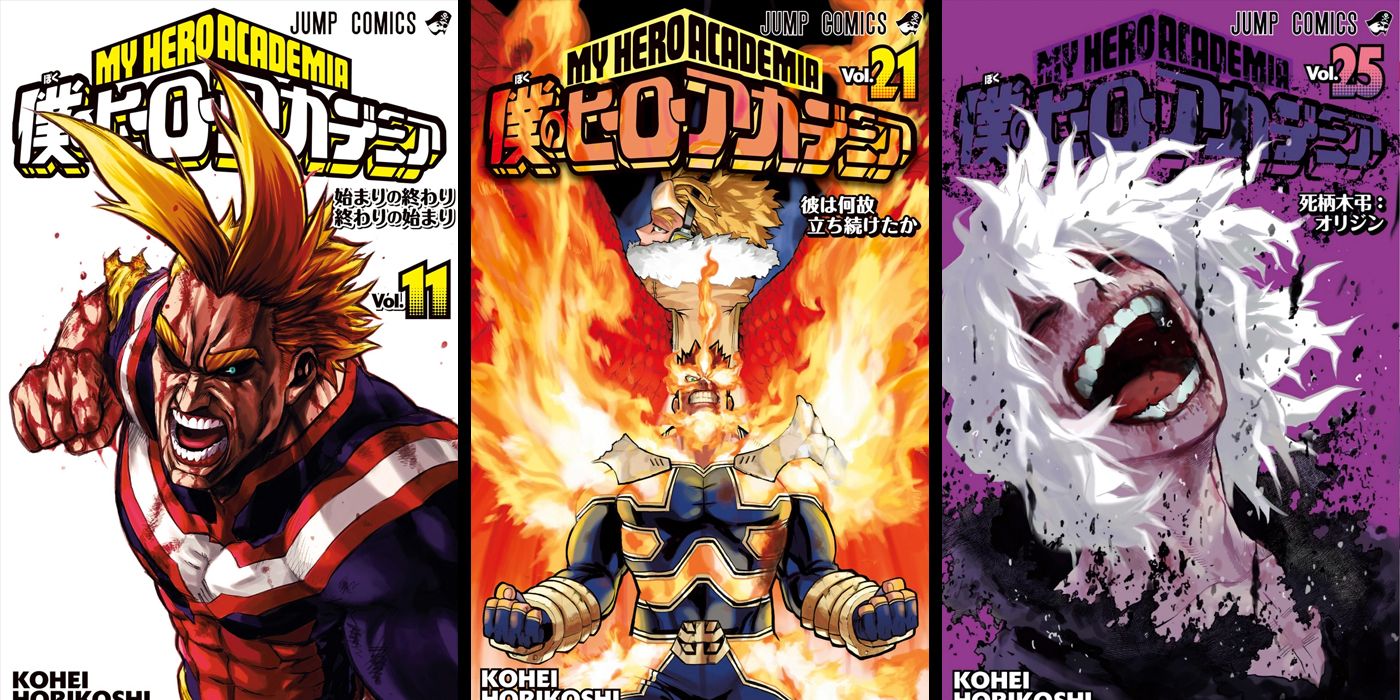
Volume 21 features the intense battle between Endeavor and High-End Nomu, with the cover art showcasing a powerful image of Endeavor in action. Hawks' presence behind him adds to the tension, as his role in the battle is ambiguous at this point.
Volume 25 delves into Shigaraki's dark past, with the cover art capturing his maniacal laughter and blood-stained face. The detailed artwork emphasizes his madness and dangerous nature, making him appear even more terrifying.
"Two Flashfires," showcases the intense showdown between Shoto Todoroki and his brother Dabi during the Final War arc. As they battle with their Quirks, both are desperate to end the conflict. The cover art demonstrates Dabi's burned and damaged appearance, reflecting his determination to strike back at his family no matter the cost. Meanwhile, Shoto wields his father's powerful move, the Flashfire Fist, in an epic display of willpower.
Volume 11: "End of the Beginning, Beginning of the End," features All Might's epic battle with All for One, marking the end of his career as the Symbol of Peace. The cover art shows All Might's ferocious determination as he unleashes a powerful attack, despite being covered in blood and in tattered costume. This volume is a testament to All Might's resilience and strength, making it the best cover art in My Hero Academia history.
My Hero Academia is a series that follows Izuku Midoriya, known as Deku, who, unlike others, does not possess a superpower called a quirk. Despite this, Deku has always aspired to be a hero, especially after encountering the number one hero, All Might. Through a twist of fate and after saving a classmate from danger, Deku inherits the One-For-All quirk and begins his journey to becoming a true hero. The series is set at the UA school, where future heroes are trained through a variety of tasks and challenges. My Hero Academia explores Deku's growth as he learns what it takes to be a hero while facing formidable supervillains. The show features an ensemble cast and first premiered on April 3, 2016. With five seasons and a total of 113 episodes, the series is produced by Bones and has become a popular part of the My Hero Academia franchise. For more information, the official website for the series is https://www.funimation.com/shows/my-hero-academia/.